
Our tryst with transparency: bringing proof to CSR across India
India asks its companies to give. We want every rupee of that giving to be seen arriving, unit by unit, in a record anyone can check.
India is one of very few countries where companies of a certain size are required by law to spend on social good. Since 2014 Section 135 of the Companies Act has turned corporate social responsibility into a duty, guided by the activities listed in Schedule VII. It was a bold idea, and it has funded schools, clinics and livelihoods across the country.
Yet ask a CSR head what keeps them up at night and the answer is rarely the size of the budget. It is the question that follows the money. Did it really reach the people it was meant for?
Where the trust gap lies
Today most CSR reporting rests on paperwork: utilisation certificates, annual reports and a handful of photographs. They tell a Board that money was spent. They rarely show, unit by unit, what that money became. And once a report is filed nobody outside can easily check it.
The rules have been moving in the right direction. Implementing agencies now register with the Ministry of Corporate Affairs (the CSR-1 form), and larger projects need independent impact assessments. What is still missing is evidence that is fine-grained, timely and open to anyone.
Reported today
- Utilisation certificates
- Year-end annual report
- A handful of photos
- Hard for anyone outside to check
Proved with Heartswill
- Every unit counted: a school day, a meal, a pair
- Two named witnesses and consent
- Photos fingerprinted and sealed
- Open ledger anyone can re-check
What we set out to build
Heartswill started with everyday purchases, where a ₹50 pledge from one order travels to one child and comes back as proof. We realised the same rails could carry CSR. A grant is simply many units, and each unit can be proved.
- Eligible partners only. CSR funds go to NGOs with a live CSR-1 registration, valid 12A and 80G, a track record and a bank account in their own name. We check the Ministry's records ourselves, not just a certificate.
- Utilisation, evidenced. Every school day, meal or pair of slippers a grant pays for is delivered with two named witnesses and consent, photographed and sealed in a public ledger.
- Seen as it happens. A CSR Committee sees utilisation live on a dashboard, not only at year end, with a Board-ready export and data an independent assessor can verify.
The lines we will not cross
- Heartswill is not an implementing agency and never holds CSR funds. Companies pay the NGO directly under their own MoU.
- We take no cut of CSR money.
- CSR grants are kept separate from purchase-linked pledges, so CSR is never used for product marketing.
- The CSR Committee approves projects, the Board signs off the policy and report, and the company files its own disclosures.
A record that cannot be quietly rewritten
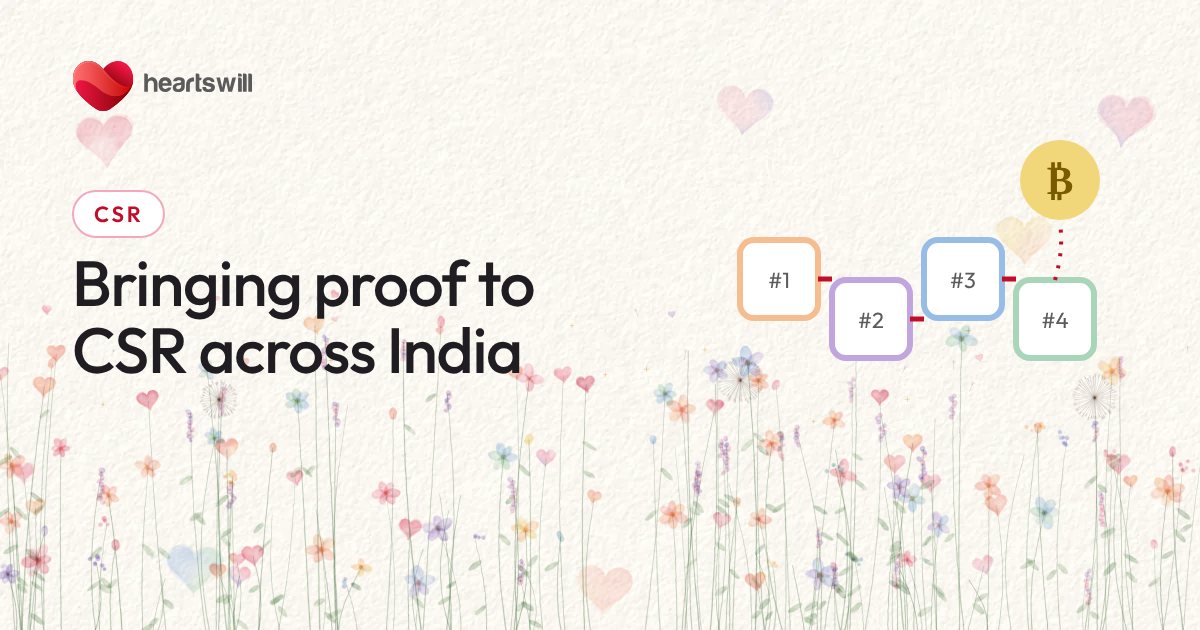
Grants, payments, deliveries and photos each become a numbered record that locks the one before it. Once a day the latest fingerprint is stamped into the Bitcoin blockchain. A company's auditors, its impact assessors and any curious citizen can verify the record independently.
We have also filed an Indian patent application for Heartswill Field Evidence Capture, the next generation of how delivery proof is captured on the ground (application no. 202611136329, filed 14 November 2026). Patent applied for. No patent has been granted yet. Today's live proof is photo fingerprints, two witnesses and a public ledger anchored to Bitcoin.
Across the nation
Our tryst is not with one company or one cause. It is with a simple standard we would like every rupee of social spending in India to meet: show the help, not just the spend. We begin with clear units like ₹30 for one school day for a girl, verified NGOs and an open ledger. Heartswill opens fully on 1 January 2027, and we would love CSR teams who share this hope to plan with us now.
This post is general information, not legal or tax advice. Please confirm CSR treatment with your company secretary or CSR advisor.